

Baptised into tenderness.
A sermon for Epiphany 2 │ The feast of the Baptism of our Lord

Isaiah 42:1-9 & Matthew 3:13-17
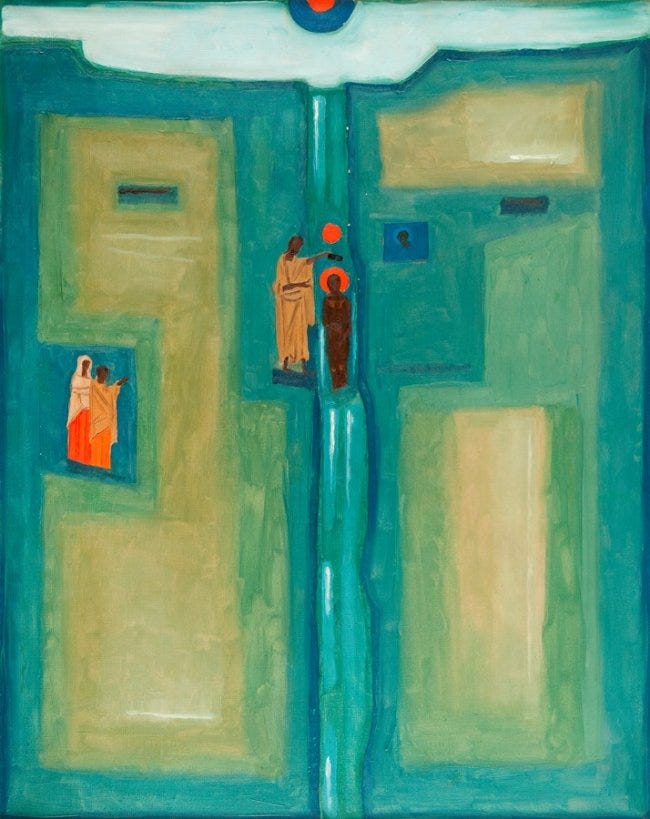
The word that best sums up our passages today is tenderness.
God spoke to Isaiah of the “new things” that He was making “spring forth”, describing the seed – His seed – planted upon the earth in the womb of Mary. God describes Jesus to Isaiah by saying,
“He will not cry out or lift up His voice in the street; a bruised reed He will not break, and a dimly burning wick He will not quench…”
It is the Season of Epiphany, which is, in effect, a continuation of the Holy Night of Christmas and the remembrance of the birth of Christ. During Epiphany we celebrate the manifestation of our Lord; like one who publishes a “manifesto”, God has “gone public” in the world. He has laid Himself bare, He has shown us His intent, His goal, and the ways in which He will accomplish them.
But, unlike the manifesto’s we hear from our political leaders – which sadly are all too often recipes for unfulfilled expectations, disappointments, virtue signalling, and false promises – God’s manifesto, proclaimed in the birth of Christ, will not be met with fanfare and loud proclamations, God does not arrive with pomp and circumstance, He does not cause a scene, or make a fuss, instead He arrives with tenderness;
“a bruised reed He will not break.”
As Rahner, reflecting on the feast of the Epiphany, once wrote,
“In effect, this feast speaks to us and says: behold, God is present, still, quiet and gentle, just as the spring remains in the tiny seed, quiet and certain of victory, hidden under the wintry earth, yet already more powerful than all the darkness and all the cold.”
- Karl Rahner, The Great Church Year
God is here, still, quiet, gentle, and certain of victory.
It is in the increasingly rare moments of human tenderness, that God’s power and presence might be most fully felt. I remember when our son was born, and I stayed up all night in the hospital just watching him as he slept cocooned inside my dressing gown. I’m certain that those few tender hours in the quiet of the night as he was cradled in my arms, were hours spent in the presence and power of God.
But it's curious that in a season which is designed to help us reflect with greater intensity on the tender moments surrounding the birth of Christ, that by week two of Epiphany, the lectionary would have us focus on His baptism. However, it’s not so odd when you consider that baptism itself is a kind of birth.
Though not one of our readings today, this much is clear in the third chapter of John’s Gospel, where Jesus says to the Pharisee Nicodemus,
“No one can see the kingdom of God without being born from above… You must be born of water and the Spirit.”
- John 3:3 & 5
These aren’t two different birth’s He’s referring to, but they are one and the same, because the birth He intends is the rebirth of Baptism – when we are baptised, we are baptised in Christ, into His baptism, and we are “born again.”
When Matthew describes Christ’s baptism, he does so in terms of both water and the Spirit. We’re told that as Jesus came up out of the water, He saw the Spirit of God in the form of a dove descending from above and alighting on Him. But contrary to John’s Gospel, in which John the Baptist sees the Spirit descending like a dove, Matthew is a little more ambiguous about who saw it.
The way the words run in Matthew’s account makes it appear as though it is Christ Himself who saw the Spirit descend upon Him; we’re not told that anyone else saw and Matthew is reticent to provide any more detail. Again, this would make sense if God is not interested in making a spectacle of Himself, if he does not cry out or lift up his voice or make it heard in the street. It makes sense if God’s ways are still, quiet, and gentle. The dove was in a sense for Jesus’ eyes only.
But Matthew records what Jesus saw, as a sign for us, not only so that we can be sure of who Jesus is – that He is God’s chosen one anointed with the Spirit – but so that we can know that the way God is with Christ, is the way that God wishes to be with us; tender like a dove, God desires to descend and tenderly alight upon you with grace.
The way God is with Christ,
is the way that God wishes to be with us.
This imagery of the dove landing on Jesus is also loaded with meaning from the story of Noah in Genesis. As the rains of the flood subsided, and - just as in baptism - the Sin of the world was washed away, a dove is chosen as the sign of God’s redemption and of the fulfilment of God’s promises. Noah sends the dove out three times.
In the first, the dove returned having found no land on which to set its foot.
In the second instance, the dove returns with an olive branch in its beak.
And in the third, the dove never returns.
In the Baptism of Christ, the Spirit finds a place to alight.
In the Cross of Christ, the Spirit finds a tree which indicates that salvation is at hand.
And in the Body of Christ, the Spirit of God is sent out into the world.
But what of the symbolism of the water? It’s curious that Jesus asks John to baptise Him. Even John questions it.
Why should Jesus need to be baptised?
He has nothing, no sin from which He needed cleansing, there was nothing wicked to wash away, He was already clean. The Apostle Paul, in a classic Pauline riddle points to an answer to this question,
“For our sake God made the one who knew no sin to be sin, so that in him we might become the righteousness of God.”
- 2 Corinthians 5:21
Jesus’ baptism is not arbitrary, but as with His whole life and ministry, it is pointing to the tree where Sin was defeated. Just as in His birth, Jesus’ death is foreshadowed by the magi’s gifts of frankincense and myrrh which were used for embalming corpses, and by being laid in a manger, swaddled in cloths like a mummy, here in His baptism, the symbol of water foreshadows the water and blood that poured from His side when the centurion speared Him.
It’s not that Jesus was baptised because the water did something to Him, rather Jesus was baptised because He did something to the water…
…such that when we entered the waters of baptism we participated in the death and resurrection of Christ.
There is nothing so still, quiet, and gentle – to borrow Rahner’s turn of phrase once more – as a corpse. God is most fully manifest when Jesus is lifted up and exalted upon the Cross. There God took all the worst that humanity could throw at Him, the violence, shame, depravity, and all the inventions of a corrupted imagination, and instead of responding in kind, with retribution and punishment, he took it all upon Himself, absorbed it, and put it all to death in His own body. The bloodied and limp corpse of Christ hangs, arms outstretched in a gesture of loving embrace, the broken body, the blood outpoured, the waters of baptism flowing from His side, as a sign of God’s tenderness.
The tenderness of God
is mightier than the power of man;
God’s tenderness is infinitely more powerful than the worst evils humankind can conjure up.
We desperately need tender-hearted people in the world today who do not respond to evil with evil, or pain with pain. We need the kinds of Christ-shaped people who respond to shame with justice, disgrace with grace, hate with love, and violence with tenderness, because the world we live in right now is in such short supply of it.
As Chris Green put it in his sermon All Life Comes from Tenderness (which is also the title of the most excellent book where the sermon can be found),
“We are all of us so afraid and confused. How often do we defend ourselves, most unconsciously, against the Spirit’s whispers and nudges? All the Spirit desires however, is to make us tender (not sore!), responsive (not sensitive); to make it so that we can live with feeling, with touch―without being touchy.”
There is already enough division and plenty of tyrants in the world, which is why we so desperately need people who have known and experienced the tenderness of God.
By virtue of your baptism, baptised in Christ, washed with the waters of life and the anointing of the Spirit, you are exactly what the world needs. Because you have been baptised into Christ Jesus, because we are His body, the words of Isaiah, can just as rightly be spoken of about us:
You are God’s servant, whom He upholds,
His chosen, in whom His soul delights.
He has put His Spirit upon you;
So that, you might bring justice to the nations.
You will not make a scene or a spectacle;
but in the still, quiet, and gentle ways of God,
you will not break the broken-hearted,
or quench the Spirit’s work,
but you will nevertheless be harbingers of God’s tender justice.
You will not grow faint or be crushed,
until God has righted every wrong.Thus says God, the LORD,
who created the heavens and the earth,
who gave you life and Spirit,
I am the LORD; and I have called you in righteousness;I will take you gently by the hand, and I will keep you close.
Amen.